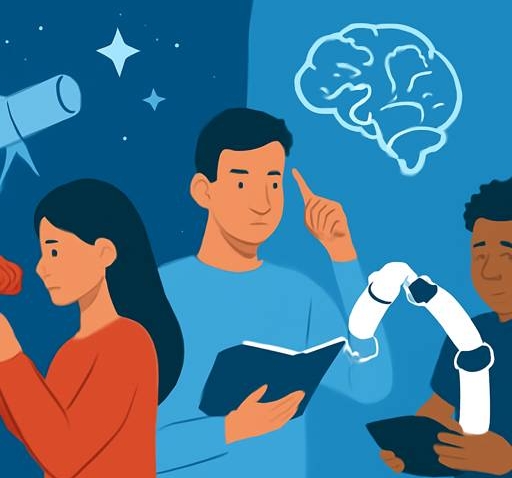
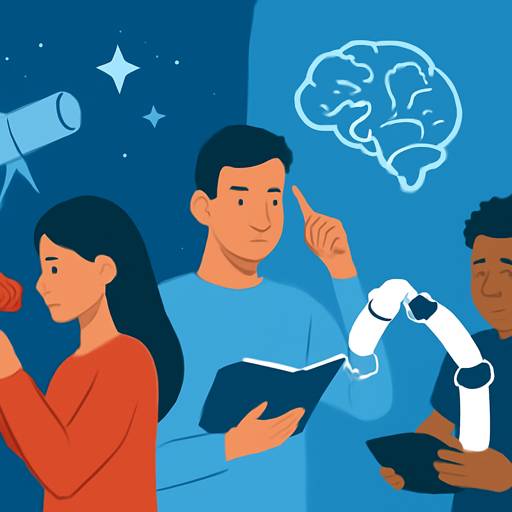
Curiosity is the engine of STEM, and few themes spark it like astronomy, the science of mind, and intelligent machines. With open datasets from space observatories, accessible behavioral experiments, and affordable robot kits, learners can build meaningful projects that mirror professional research. Whether you’re sketching light curves from distant worlds, designing a memory study, assembling a biped that can take its first steps, or coordinating a fleet of tiny rovers, the skills you sharpen—data literacy, critical thinking, and iterative engineering—travel with you across disciplines. Below, discover practical, high-impact pathways in astronomy research ideas, Space Telescope Projects, cognitive science for high school explorations, and hands-on builds in humanoid robotics for students and Swarm robotics student projects.
Astronomy Research Ideas Powered by Open Space Telescope Data
Astronomy is uniquely democratic: world-class data streams are public, inviting learners to conduct real analyses and contribute to discovery. Start with the Mikulski Archive for Space Telescopes (MAST), home to Hubble, TESS, and other missions. A classic student path is exoplanet hunting with TESS. Download target light curves and apply transit-search algorithms—such as Box Least Squares—to detect periodic dips in brightness that hint at orbiting planets. Tools like Lightkurve and AstroPy make this workflow approachable, turning raw photons into plots and statistical fits. As skills deepen, students can investigate planet candidates, cross-check catalogs, and simulate false positives caused by stellar variability or systematics.
Variable star studies are equally rewarding. Classify Cepheids or RR Lyrae using period-luminosity relationships; calculate distances; then compare findings with Gaia parallaxes to see how independent measurements converge. For a galaxy-focused route, dive into image sets from Hubble or JWST to examine morphology, dust lanes, or star-forming regions. Machine learning adds a modern twist: train a simple CNN to distinguish spirals from ellipticals, or segment nebular regions to estimate star-formation proxies. Even without a telescope, students can process archival FITS images, stack frames, subtract backgrounds, and calibrate photometry to transform pixel values into physical insight.
Grounded case work helps projects sing. A high school team might select a dozen TESS targets, generate phase-folded light curves, and compute signal-to-noise ratios for candidate transits. They could rule out false signals by checking centroid motion or comparing simultaneous observations across apertures. Another group could replicate historical Hubble measurements of a globular cluster’s color-magnitude diagram, then model stellar evolution tracks to infer age and metallicity. For early learners, start small: lunar crater counts from backyard photographs can teach statistics and impact chronology. Progression matters—each step develops error analysis, documentation discipline, and computational fluency that strengthens future Space Telescope Projects.
Cognitive Science for High School: Experiments That Illuminate How Minds Learn
Understanding cognition turns everyday experiences—reading, remembering, choosing—into measurable phenomena. Students can design controlled experiments with widely studied tasks. The Stroop task reveals selective attention by measuring the interference when color words and ink colors mismatch. The serial position effect highlights how we recall early and late items in a list better than those in the middle. The n-back task explores working memory load and performance trends across difficulty levels. With free tools like PsychoPy, OpenSesame, or browser-based jsPsych, learners can build experiments, collect reaction times, and export clean CSVs for analysis in Python or spreadsheets.
Ethics belongs at the center. Projects should use informed assent/consent, anonymize data, and avoid sensitive measures. Pre-registering hypotheses—predicting an effect before data collection—teaches scientific rigor and guards against cherry-picking. Once data arrives, students compute effect sizes, confidence intervals, and power estimates to interpret results responsibly. A powerful entry point is the spacing effect: compare groups who study flashcards in one massed session versus spaced sessions distributed across days; include a delayed test to see long-term retention advantages. Another is testing effect research: examine how practice retrieval outperforms passive review, then translate findings into study strategies for peers.
Cognition bridges to technology and design. Human-computer interaction projects can test interface changes—font size, color contrast, or notification timing—on reading speed and accuracy, connecting perception research with accessibility. Bias and decision-making studies might adapt simple framing effects to show how wording shifts choices. For mentorship, resource libraries and communities supporting cognitive science for high school projects can help teams craft responsible protocols and robust analyses. By combining principled experimentation with clear visualizations—reaction-time histograms, pre/post plots, or mixed-effects models—students surface patterns that improve learning, communication, and technology use in everyday life.
Humanoid Robotics for Students and Swarm Robotics Student Projects
Robotics blends mechanics, electronics, and algorithms into tangible systems that learn and adapt. For humanoid robotics for students, begin with a clear scope: prioritize biped balancing and simple gait cycles before adding arms, hands, or vision. A torso-hip-knee-ankle configuration with affordable servos offers enough degrees of freedom for walking experiments. An IMU (accelerometer and gyroscope) enables sensor fusion—often via a complementary filter or a lightweight Kalman filter—to estimate tilt and correct stance in real time. Gait control can start with keyframed joint trajectories, then evolve to central pattern generators (CPGs) for smoother, adaptive locomotion. To avoid complex inverse kinematics early, learners can use pose libraries and spline interpolation between stable support phases.
Microcontrollers like Arduino or STM32 handle low-latency control loops, while a single-board computer such as a Raspberry Pi runs higher-level logic, computer vision, or wireless logging. Vision modules using lightweight pose estimation can trigger gestures or capture markers for balance feedback. Safety and maintainability matter: enforce current limits to protect servos, design 3D-printed brackets with stress-relief fillets, and modularize wiring with labeled harnesses. A compelling student milestone is a “stand-recover-walk” routine: detect a fall, reorient safely, stand, then take several measured steps on a foam mat. Documenting oscillation damping, step length variance, and battery load profiles adds research-quality depth.
On the collective side, Swarm robotics student projects highlight the power of simple rules at scale. Even with three to eight low-cost robots, teams can prototype flocking and formation control using consensus or potential-field algorithms. Micro:bit or Arduino-based rovers with distance sensors and Bluetooth or Zigbee radios allow distributed control: each agent updates velocity based on neighbors’ positions and obstacles. In simulation (Webots, CoppeliaSim, or ROS 2 Gazebo), students can iterate quickly—measuring coverage rates, collision counts, and energy use—before transferring policies to hardware. A classic demonstration is target search and coverage: agents spread out to maximize area scanning, then converge via gradient cues when a target is detected.
Case studies bring swarms to life. A club could build six palm-sized robots, calibrate odometry on a grid, and implement a leaderless formation using only relative bearing and inter-robot distance thresholds. Adding resilience testing—removing one agent mid-run—lets students measure how consensus re-forms, a hallmark of robust swarms. Another project marries cognition and robotics: use human behavioral data (e.g., exploration strategies) to parameterize robot search heuristics, then compare outcomes. Whether humanlike locomotion or emergent cooperation is the focus, the engineering practices are the same: tight feedback loops, reproducible experiments, and clear metrics that transform a weekend build into publishable insight.
These pathways interlock. Space science exercises quantitative modeling, cognitive studies refine experimental judgment, and robotics fuses both into embodied intelligence. Students who iterate across domains gain a rare toolkit: the patience to clean data, the creativity to test ideas, and the systems thinking to make distant stars, human minds, and collaborative robots understandable—and buildable.